‘STILLNESS’
Isabella Dyson and Marie-Louise Munch
Bringing together the artist and paintings of Isabella Dyson with the Danish architect ceramicist Marie-Louise Munch
EXHIBITION
NOVEMBER
TICKNER BELL YOUNG & LEBENSON
GALLERY46
46 ASHFIELD STREET
LONDON E1 2AJ
Artists
Isabella Dyson is a practicing artist exploring muted colours and forms. She studied at London Metropolitan University, before pursuing her career in Fine art. She is interested in simple design and muted colour palette and abstraction and how to explore both themes in her work. Morandi is a strong influence to both Isabella and Marie Louise’s work.
The simplicity and stillness is something they captivate in this exhibition and the rough texture of an object up against paintings in situ, an how these two ways of working connect with one another.
Information
GALLERY46 announces STILLNESS, a new exhibition bringing together British artist Isabella Dyson and Danish architect and ceramicist Marie-Louise Munch. Across painting and ceramics, the exhibition explores a shared language of landscape, still life, architecture and silence.
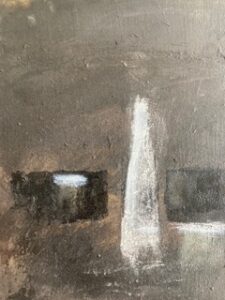
Dyson’s paintings have long been attentive to the landscape, not simply as a subject to be depicted, but as a place in which colour, atmosphere and memory accumulate. In STILLNESS, her landscapes feel less like windows onto a particular view than distilled states of looking. Horizons become suggestions; expanses of colour carry the weight of weather and light; familiar places are reduced to their quietest essentials.
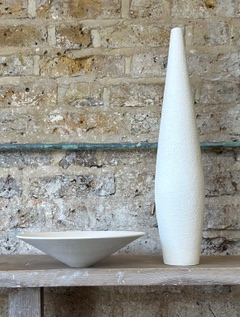
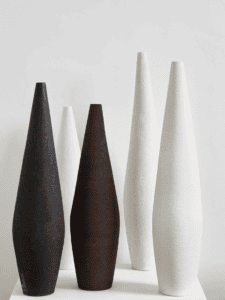
Alongside Dyson’s landscapes, the exhibition introduces a body of ceramic work by Munch, whose practice sits naturally between architecture and the handmade. Her vessels and sculptural forms possess an architectural clarity, yet their surfaces retain the irregularity and warmth of touch. Placed among Dyson’s paintings, they begin to read almost as miniature architectures, objects that occupy space in the same way that Dyson’s paintings create it.
The works and dialogue recalls the still lifes of Giorgio Morandi, whose modest arrangements of bottles, boxes and vessels became studies in proportion, light and infinite variation. Morandi understood that very little is required to make a picture: a few forms, carefully placed, can contain an entire world. That sensibility is present throughout STILLNESS. Munch’s ceramics and Dyson’s paintings share an interest in the ordinary transformed through attention. A vessel becomes a presence; a landscape becomes an arrangement of tones; an empty space becomes as important as the objects or forms within it.
There is also a refusal of spectacle, rather than demanding attention, the works accumulate it, their power lies in subtle distinctions, the relationship between one muted colour and another, the shift of a contour, the space separating two forms. What initially appears quiet becomes increasingly complex the longer one looks.
Dyson’s relationship with landscape and Munch’s architectural approach to ceramics meet in this same territory, both artists are concerned with how we inhabit space, and with how objects, surfaces and horizons can become carriers of emotion without declaring themselves as such. The exhibition might therefore be understood as a composition in its own right. Paintings and ceramics are arranged not according to medium but according to affinities of colour, form and proportion. A ceramic vessel can seem to continue the geometry of a painted landscape; a painted horizon can flatten and expand the physical space around an object.
If Morandi found endless possibility in the smallest collection of things, STILLNESS proposes a similar economy: landscape and vessel, painting and object, earth and colour. Nothing is overstated. Everything is given time.
In an age of constant visual noise, STILLNESS makes a case for another kind of looking; slower, closer and more attentive.